
The phrase "AI sports betting tool" can mean five very different things. Some apps scan a player-prop board. Some let you build custom models. Some answer questions in a chat window. Some grade picks quickly. Some, like Juice, start with the bet you are already considering and turn it into a clear research report.
That distinction matters. A beginner does not always need the biggest dashboard. A serious bettor does not always need another black-box pick. The best AI sports betting tools help you understand the market, the price, the probability, and the risk before you place a wager.
We rebuilt this guide around use case, not around whoever happens to rank for a similar keyword. Juice publishes this guide and is one of the products discussed, so treat it as a buyer's guide from our point of view, not a neutral award show. No app in this list can guarantee profitable betting.
Quick answer: Juice is best for beginners who want clear bet-slip research. Rithmm is best for custom AI models. Outlier is best for prop research. OddsJam and Sharp App are best for real-time +EV and arbitrage scanning. Pikkit is best for tracking your own bets. Unabated is best for advanced fair-price work. Action Network and Dimers are better as context and projection layers.
Best AI Sports Betting Tools at a Glance
| Tool | Best for | Core workflow | Beginner fit |
|---|---|---|---|
| Juice | Simplicity, clarity, and deeper bet-slip research | Upload a screenshot, get multi-model AI analysis, compare odds, and see EV | High: starts from a bet the user already understands |
| Rithmm | Custom AI models and model-backed picks | Inspect predictions, model win chance, model reasoning, and line context | Medium: powerful, but more model-oriented |
| Outlier | Deep player-prop research | Evaluate trends, injuries, matchup data, public sentiment, line movement, and EV indicators | Medium-high: best if props are your main market |
| OddsJam | Real-time +EV and arbitrage scanning | Scan odds across many sportsbooks for mathematically mispriced markets | Medium-low: powerful, but less beginner-friendly |
| Sharp App | Fast +EV, arbs, pick'em props, and player-prop projections | Use a mobile-first market scanner across 100+ sportsbooks and apps | Medium: best for users ready to act quickly |
| Pikkit | Tracking, self-auditing, and social betting context | Sync sportsbook accounts, track history, analyze results, and follow community action | High: useful even before advanced modeling |
| Unabated | Advanced odds screens and fair-price comparison | Compare market prices against Unabated Line, props tools, simulators, and odds screens | Low-medium: strongest for sharper bettors |
| Action Network | News, projections, odds, and market context | Track odds, public betting, expert analysis, projections, systems, and news | High: familiar media/app workflow |
| Dimers | Predictions and model-driven research | Use model-backed predictions, picks, odds pages, and Dimers Pro/Platinum where available | High: strong for casual research context |
How We Compared the Tools
This is a documentation-based comparison. We did not run an independent betting-return benchmark or test every paid plan. “Best for” labels describe a suggested workflow fit, not a proven ranking of profitability.
This is a workflow comparison, not an accuracy leaderboard. Sports betting performance claims are hard to compare because every product can use different markets, prices, timing, staking, grading rules, and sample windows. A 60% hit rate can be excellent at plus money or useless at the wrong price.
Instead, we looked at the product experience a real bettor can inspect: what decision the tool helps with, whether it shows line and price context, how much explanation it provides, how beginner-friendly it feels, and whether the user can check the result before risking money.
The most useful AI sports betting tools should do at least three things:
- Show the price. A pick without the current odds is incomplete.
- Explain the why. A grade is more useful when the user can see injuries, matchup context, line movement, or probability logic.
- Respect uncertainty. Good tools help you make better decisions. They do not pretend variance disappears.
1. Juice: Best for Simple, Clear Bet Research
Juice is built for the bettor who already has a bet in mind and wants to know whether it makes sense. Instead of asking you to build a model, scan a giant board, or interpret dozens of tabs, Juice starts with a screenshot. Upload a bet slip from your sportsbook, and the app turns that bet into research.
The value is clarity. Juice compares analysis from ChatGPT, Claude, Gemini, and Grok, estimates probability and expected value, and offers available odds across 20 supported platforms: FanDuel, DraftKings, BetMGM, Caesars, Bet365, Bovada, Hard Rock Bet, BetRivers, Fanatics, theScore, MyBookie, BetUS, Fliff, PrizePicks, Underdog, Betr, Novig, ProphetX, Kalshi, and Polymarket. These include sportsbooks, pick'em services, and prediction markets, not 20 equivalent sportsbooks. Coverage, market structure, access, and settlement rules vary.
That workflow is especially useful for beginners because the entry point is not abstract. You do not have to know how to build an AI model. You do not have to understand every projection metric on day one. You can start with a real line, see what matters, and learn from the explanation.
Juice is also a good fit for bettors who care about depth but do not want research clutter. The report focuses on the question that matters: is this price attractive relative to the estimated chance of winning? If you want to check the math yourself, our free sports betting EV calculator and odds converter are available on the web.
Research any bet slip in seconds.
Upload a sportsbook screenshot, get AI analysis from multiple models, compare odds across 20 supported platforms, and see whether the bet has positive expected value.

Screenshot Research or Ask Juice?
Use a screenshot when you have a specific bet and price to investigate. Use Ask Juice when you want to research a game, player, market, or line movement through a question. The current App Store listing describes both workflows. Some features require a subscription or credits, so check current terms in the app.
A Concrete Example of Reading an AI Estimate
An actual archived Juice report from July 23, 2026 shows a 40% probability estimate at +233 odds. At a hypothetical $100 stake, estimated EV is (0.40 × $233) minus (0.60 × $100), which equals +$33.20. That number is conditional on the 40% estimate, not evidence that the estimate is accurate or a promise of profit.
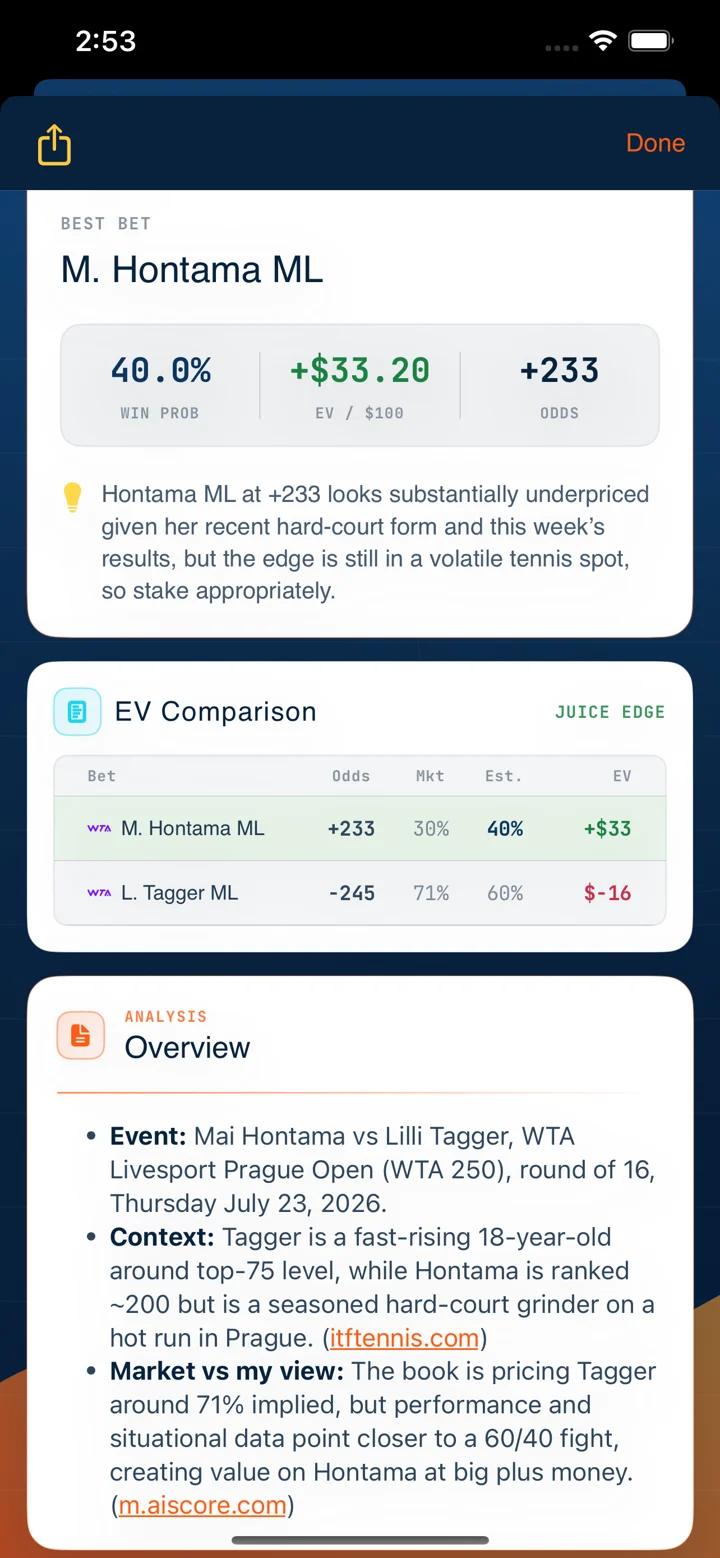
If the true probability were only 25%, the same odds would produce estimated EV of negative $16.75 per $100. Check the input probability, available price, sources, and timing before treating an AI result as useful. The historical screenshot illustrates the report and calculation, not verified player facts or a current betting recommendation.
2. Rithmm: Best for Custom Models
Rithmm is a stronger fit for bettors who want model-backed predictions and more control over the decision process. Its official site describes AI sports predictions, player prop analysis, model reasoning, and line comparisons, with a seven-day free trial for new members.
Rithmm supports model-backed predictions and also offers Scout AI chat on selected plans, including research on a bet you already have in mind. Its workflow overlaps with Juice, so compare the current plan, sports coverage, explanations, and research interface rather than treating one product as exclusively model-first and the other as exclusively bet-first.
The tradeoff is complexity. A beginner may find model terminology and prediction surfaces useful, but it can also create more decisions: which model, which market, which edge threshold, which line, and which sport. Rithmm is best when the user wants to spend time learning the model environment.
3. Outlier: Best for Deep Player-Prop Research
Outlier is the stronger choice if your betting life revolves around player props. Its official product pages emphasize performance trends, injuries, matchup data, public sentiment, line movement, odds comparison, EV+ indicators, sharp-book odds, boosts, middles, arbitrage, and real-time alerts.
That is a very different use case from a simple bet-slip analyzer. Outlier is for bettors who want to research the board, compare markets, and find prop candidates before choosing a bet. If you already know the bet you want analyzed, consider Juice's screenshot workflow. If you want to search a prop board, compare Outlier's research interface and current plan coverage.
The tradeoff is density. Outlier gives serious prop bettors a lot to inspect. Advanced features and access vary by plan. Beginners may need time to learn which trend, line-movement, and EV signals matter most.
4. OddsJam: Best for Real-Time +EV and Arbitrage Scanning
OddsJam is not just an AI app, and that is the point. It is one of the clearest tools for bettors who want real-time market scanning. Its Positive EV product is positioned around market-price comparison and opportunity scanning. Confirm the current sports coverage, included tools, and plan terms directly with OddsJam before buying.
OddsJam is best for bettors who already understand execution. +EV and arbitrage feeds can be valuable, but they move fast. A user needs funded books, discipline, bankroll rules, and a willingness to act before the number disappears.
For beginners, OddsJam can be more than necessary. For serious bettors who want to attack mispriced markets, it belongs near the top of the stack.
5. Sharp App: Best for Mobile +EV, Arbs, and Pick'em Props
Sharp App is another market-scanning product, but its current positioning is broader than a basic odds board. The official site describes real-time arbitrage, +EV, player-prop projections, a daily Sharp Report, prediction markets, pick'em tools, and 100+ sportsbooks and apps scanned.
That makes Sharp App a fit for bettors who want speed, mobile access, and market intelligence in one place. It is especially interesting for users who bet across traditional sportsbooks and pick'em or prediction-market products.
The caution is the same as with any fast market scanner: the tool can identify opportunities, but the bettor still has to place bets cleanly, manage limits, and avoid overbetting short-lived signals.
6. Pikkit: Best for Tracking and Self-Auditing
Pikkit is not primarily an AI handicapper. It earns a place here because a bettor's best research tool is often their own betting history. Pikkit syncs sportsbook accounts, tracks bets, supports social sharing and line shopping, and gives users analytics on their betting behavior.
That matters because many bettors do not lose from one bad pick. They lose because they cannot see patterns: chasing parlays, overbetting favorites, ignoring line price, or performing worse in some sports than others. A tracker can expose those leaks.
Use Pikkit alongside an AI tool, not instead of one. Juice can help research a specific bet. Pikkit can tell you whether the way you bet those recommendations is actually working.
7. Unabated: Best for Advanced Fair-Price Work
Unabated focuses on advanced market and fair-price research. Its odds screen, props simulator, pick'em tools, market-based player data, and fair-price concepts are designed for bettors who care deeply about the number.
The key feature concept is the Unabated Line: a curated, vig-free reference informed by sharp market prices, not an objective measurement of true win probability. Comparing the best available sportsbook line against a fair-price estimate is one of the cleanest ways to think about edge.
If you are new, start simpler. If you already understand devigging, market makers, alternate lines, and expected value, Unabated can be very useful.
8. Action Network: Best for News, Projections, and Market Context
Action Network is more media-and-data platform than AI product, but it remains one of the most useful context layers for bettors. Its site and app cover odds, news, expert analysis, bet tracking, public betting data, projections, and systems.
The Action Network use case is context. If a model likes a side, Action can help you understand what the market is doing, whether public and money percentages diverge, what experts are discussing, and whether news changed the setup.
Use it before final confirmation, not as a standalone bet button. A projection is more useful when paired with odds comparison and expected value.
9. Dimers: Predictions and Model-Driven Research
Dimers offers predictions, picks, odds pages, and model-backed content across major sports. Some content is accessible without a paid plan, while Pro and Platinum are subscription products. Check the current access limits and prices.
Dimers is not the deepest execution tool on this list, but it is easy to read and useful as a first-pass context source. A beginner can check a matchup, see prediction context, compare it against other research, and then use a tool like Juice or an EV calculator to evaluate the actual bet price.
Which Tools Actually Use AI?
AI research assistants and model-based prediction products are different from a tracker or an odds scanner. Juice and Rithmm offer AI-assisted research workflows. An odds scanner can compare prices mathematically without generating an AI prediction, while a tracker records results rather than estimating a game outcome. Outlier, OddsJam, Sharp App, Pikkit, Unabated, Action Network, and Dimers appear here because different parts of their toolkits may support the research process, not because every feature is generative AI.
How to Choose the Right AI Betting Tool
Start with the decision, not the brand
If you want to analyze one bet you already found, use a bet-slip research tool like Juice. If you want custom AI models, use Rithmm. If you want player-prop depth, use Outlier. If you want +EV or arbitrage feeds, use OddsJam or Sharp App. If you want to audit your own results, use Pikkit. If you want fair-price market work, use Unabated. If you want broader context, use Action Network or Dimers.
Check line and price every time
AI analysis is incomplete without the market price. A model can like a bet at +120 and hate the same bet at -110. That is why line shopping matters. Before you bet, compare odds across books and convert the odds into implied probability.
Look for explanations you can audit
Good explanations do not need to be complicated. They should tell you what factors matter, what uncertainty remains, and what price would make the bet unattractive. The best AI sports betting tools make the user smarter over time.
Use trials to test the workflow
Do not spend a free trial chasing one hot pick. Test the process. Save several recommendations with timestamps, lines, prices, and your own notes. See whether the tool helps you make clearer decisions before paying.
Built for bettors who want clarity.
Juice keeps the workflow simple: screenshot a bet, read the analysis, compare the market, and understand expected value before you risk money.
Frequently Asked Questions
What is the best AI sports betting tool for beginners?
The best AI sports betting tool for beginners is usually the one that explains the decision, shows the odds, and keeps the workflow simple. Juice is built for that use case: upload a bet slip screenshot, review plain-English research, compare odds, and see expected value before betting.
Can AI sports betting tools guarantee profit?
No. AI sports betting tools can organize research, estimate probabilities, compare odds, and identify possible value. They cannot remove variance, bad data, late injuries, line movement, or the risk of losing money.
Which AI betting tool is best for player props?
Outlier is a strong fit for prop-first bettors who want player trends, injuries, matchup data, line movement, odds comparison, and EV indicators. Sharp App and OddsJam are better for fast +EV and arbitrage feeds. Juice is useful when you already have a prop or bet slip and want deeper analysis plus odds comparison.
Are free AI sports betting tools worth using?
Free trials and free features are useful for testing workflow quality. The key is to evaluate whether the tool shows current lines, explains assumptions, compares prices, and saves real research time. Do not judge a tool only by one winning or losing pick.
Should I use AI picks or build my own model?
Use AI picks if you want speed and structure. Build or customize a model if you want control over assumptions and are willing to learn the math. Many bettors should start with simple research and odds comparison before moving into custom modeling.
Sources and Update Notes
Updated October 15, 2026. Originally published July 28, 2026. This update corrects Juice's four-model and 20-platform coverage, adds Ask Juice and an archived worked example, and clarifies overlapping tool categories. Product descriptions are based on public first-party documentation, not a hands-on accuracy test of every product. Source links for checking current features and availability: Juice, Rithmm, Outlier, OddsJam, Sharp App, Pikkit, Unabated, Action Network, and Dimers. We refreshed the accessible first-party descriptions for this update. OddsJam's current pages could not be independently rechecked, so its coverage is intentionally limited and should be confirmed before purchase. Features, prices, trials, sports coverage, and app availability can change quickly. This guide is informational and is not financial, betting, or gambling advice.